




By Stephen Kidd
Despite decades of development assistance, hundreds of millions of children across low- and middle-income countries continue to suffer from the effects of extreme poverty. Around 150 million children are stunted, 43 million experience wasting, and 250 million are out of school. Far too many children reach adulthood without any chance of reaching their full potential, and, as a result, poverty is transmitted from one generation to the next.
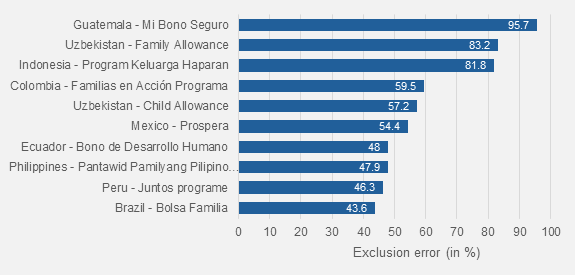
One of the best tools for tackling child poverty is a Universal Child Benefit (UCB). It’s such a simple solution: all families are provided with a regular cash benefit for each of their children. Instantly, family incomes are raised which, in turn, enables parents to invest in their children. With improved nutrition and a better chance of performing well at school, the lives of millions of children could be transformed if UCBs were established in every country. Yet, only 47 countries provide a UCB and a mere 25 per cent of children globally currently access a child benefit.¹ Too often it is claimed that UCBs are unaffordable or that it is preferable to target the poorest children, despite, as shown by Figure 1, most programmes targeting the poorest children exclude over half their intended beneficiaries. This contrasts with Mongolia’s universal Child Money Programme which excludes less than 4 per cent of children (largely due to late enrolment after birth).
Figure 1: Exclusion errors among benefits that are targeted at children living in poverty across a range of middle-income countries
In Africa, only 11 per cent of children receive any form of child benefit. Therefore, in the region of the world where UCBs are most needed, they are least prevalent. Yet, we know that they can be very effective. To prove this, in 2017 Development Pathways was contracted by UNICEF to design and build a pilot UCB in some of the most remote areas of Angola, in the provinces of Bié, Moxico, and Uíge. The scheme was known as Valor Criança. We undertook the work on behalf of the Ministry of Social Action, Family and Promotion of Women (MASFAMU). Funding from the European Union for the pilot was limited and so choices had to be made on which children to prioritise. It was agreed to support all children in specific localities under the age of 5 years, a total of 35,000 children in almost 6,000 households. We ensured that no conditionalities were used in the UCB, given the absence of global evidence on the effectiveness of conditionalities.
After building the operational systems – including a digital management information system and payment system – we handed over responsibility for managing the scheme to UNICEF in 2019, who took it forward in partnership with MASFAMU.
The UCB lasted from 2019 to 2022, providing each child initially with the equivalent of US$11 per month. Unfortunately, over time the value of the transfer was eroded by inflation, reaching as low as US$5 per month in 2020, before being adjusted upwards to US$8.60. While we had originally designed the transfer to be provided every 3 months, due to administrative challenges under COVID-19, the final transfer covered a period of 12 months. As a result of these problems, the full impacts of the UCB were never realised.
Nonetheless, despite its short duration, the UCB made a major difference to the lives of the recipient children and their families. An evaluation was undertaken by UNICEF Innocenti – see here – and the results were impressive. The programme enhanced the quality of the home environment for children and had significant positive impacts on children and their households. These included:
- There were significant improvements in children’s diets: the consumption of grains, roots and tubers increased by 18 per cent; legumes and nuts by 12 per cent; meat, fish and poultry by 24 per cent; eggs by 12 per cent; and fruits and vegetables by 10 per cent. An average of three additional food groups consumed.
- Household food security was strengthened: the number of meals eaten by households increased by 24 per cent, while the proportion of households without food for a full day fell by 12 percentage points.
- Children benefited from more material goods: children in possession of sandals or shoes increased by 47 per cent, and the likelihood of them having at least two sets of clothes and a blanket increased by 25 per cent and 49 per cent, respectively.
- Children’s access to health services improved: the likelihood of a child having a health card improved by 15 per cent; vitamin A supplements and deworming increased by 12 and 14 per cent respectively; and, the number of children receiving their full schedule of immunisation grew by 18 per cent. And, all of this was achieved without conditionalities.
- More pregnant women benefited from maternity services: the number without ante-natal care visits decreased by 28 per cent.
- Female caregivers reported feeling more empowered when making decisions: some women experienced more autonomy in decision-making while savings rates among caregivers increased by 36 per cent. Just prior to the end-line survey in 2022, they had saved US$22.50 more than non-beneficiary caregivers.
- The ownership of material assets increased in beneficiary households: telephone, radio, and motorbike ownership rose by 12.8, 26.5, and 8.6 percentage points, respectively.
- Households became more productive: the percentage of households with livestock increased by 14 per cent, while there were also improvements in the number of crops cultivated and the ownership of land for cultivation.
- Local economies became more vibrant due to the increased spending by beneficiaries: Qualitative interviews noted that a number of beneficiaries used their increased income to hire additional labour to assist in income-generating activities.
Despite the success of the scheme, it was not extended or expanded. Yet, the case for a UCB across Angola – as across Sub-Saharan Africa – is incontrovertible: 40 per cent of young children are stunted while, on any given day, only 12 per cent of children receive a minimum acceptable diet; and, the net attendance rate at primary school and secondary school is only 66 per cent and 40 per cent respectively.
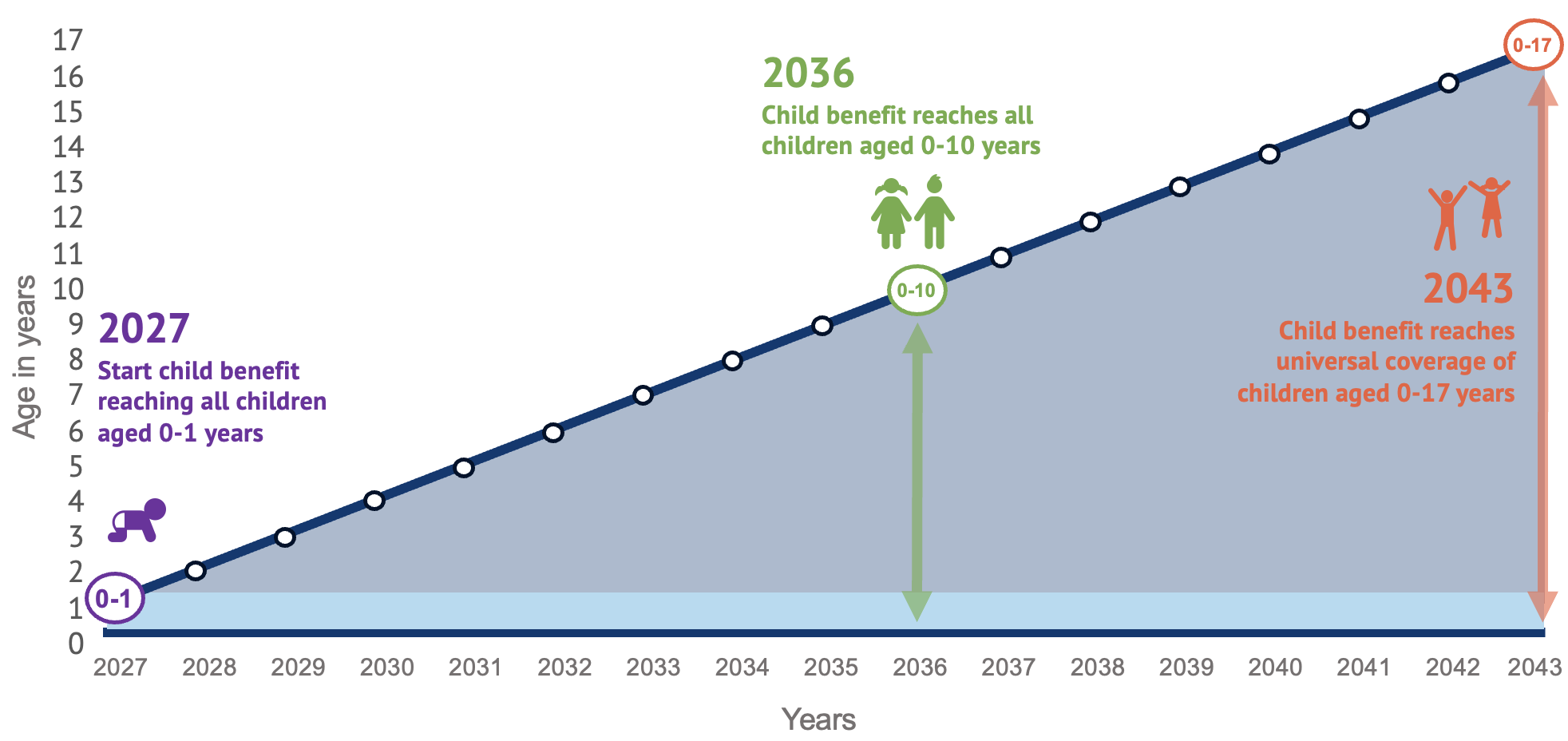
A UCB in Angola is affordable, if introduced gradually. It could begin, initially, with a transfer equivalent to US$10 per month for all under-2s and, as illustrated by Figure 2, not remove children until they reach 18 years of age. All newborns would enter the programme and, by 2043, the scheme would be fully universal for all children.
Figure 2: Illustration of the potential gradual expansion of a UCB in Angola
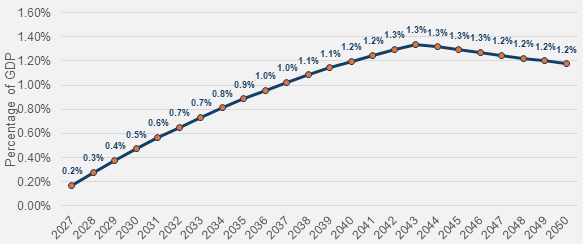
As indicated by Figure 3, the initial investment required would be less than 0.2 per cent of GDP, if the scheme were to begin in 2027. If the transfer value were indexed to inflation to maintain its purchasing power, and GDP growth were to follow that predicted by the IMF, the maximum cost of the UCB would be only 1.3 per cent by 2043, similar to the cost of South Africa’s Child Support Grant. The cost would then gradually fall due to the economy growing slightly faster than the growth in the number of children. Importantly, the annual budget required to expand the scheme to all children under-18 would be only 0.07 per cent of GDP per year, a marginal cost to the state. In fact, it could be funded by a small proportion of the new taxes generated each year by economic growth.
Figure 3: Estimated costs of implementing a UCB that reaches all children 0-17 as a percentage of GDP, 2027-2050
Angola is a young country, with children comprising 51 per cent of the population. If a UCB is feasible in Angola, it is feasible anywhere in Sub-Saharan Africa. And, as evidenced by the imperfectly implemented Valor Criança scheme, the impacts on child and family well-being would be impressive. Yet, for some reason, countries – and international donors – continue to resist introducing UCBs, the only proven means of guaranteeing a minimum level of income security for all children.
As Nelson Mandela remarked in 1995, just before he introduced the Child Support Grant in South Africa: “There can be no keener revelation of a society’s soul than the way in which it treats its children.” Children are a nation’s future and one of Africa’s greatest resources. It’s time for all countries in Sub-Saharan Africa to heed Mandela’s call by introducing UCBs. The impacts will be transformative.
¹ ILO (2024).